
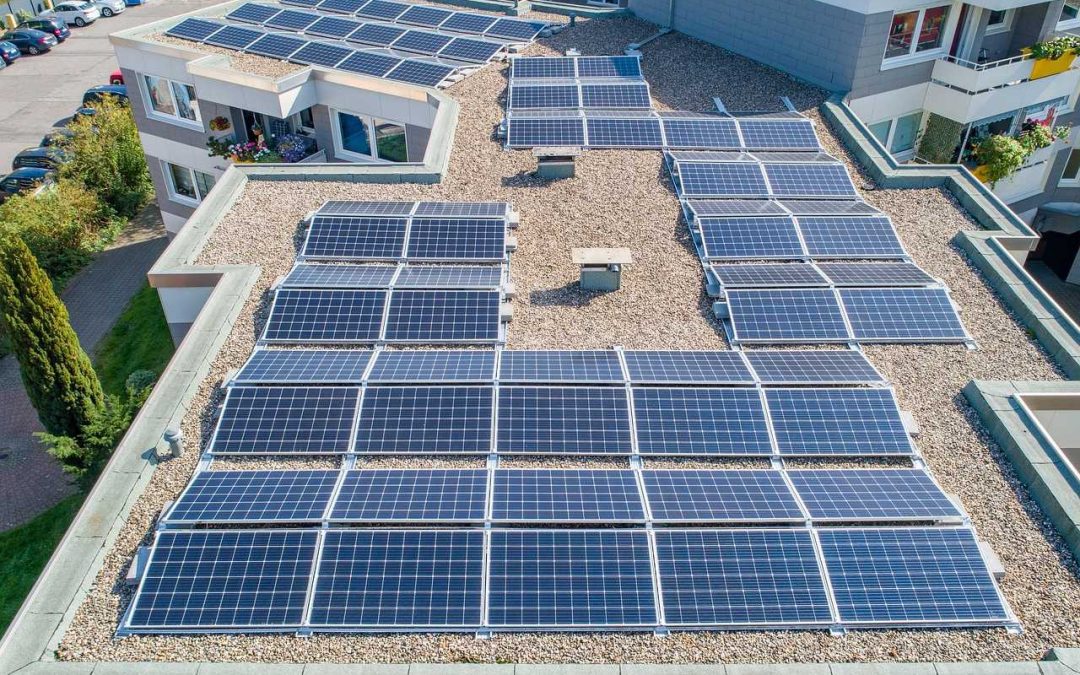
For commercial organisations in the UK today, solar isn’t just about sustainability. It’s about strategic resilience, cost certainty and measurable returns. Energy prices are still volatile and carbon commitments are increasingly central to business strategies so installing solar and integrating battery systems has become one of the smartest ways to protect margins while strengthening a company’s ESG and operational credentials.
At Verdant Future, we work with commercial clients to make these systems not only technically effective but financially compelling and future-ready. We outline below how the economics of commercial solar payback really break down in 2026.
The Financial Landscape: What Drives Payback
Commercial solar payback is essentially the point at which your investment in a system is offset by the financial benefits it delivers.
Primary Financial Drivers
- Energy cost savings: Every kilowatt your system generates reduces how much you buy from the grid, typically at much higher and ever rising rates.
- Export income (Smart Export Guarantee): Businesses can earn payments for excess electricity exported back to the grid.
- Tax incentives: The Annual Investment Allowance and accelerated capital allowances allow much or all of the system cost to be offset against taxable profits. This strengthens the upfront business case.
- Grants and regional support: Localised decarbonisation funding can reduce effective capital costs.
This combination of reduced expenditure and revenue streams means that commercial solar is no longer a long-term gamble. It is a strategic financial decision.
Typical Payback Periods You Can Realistically Expect
The payback periods vary by system size, energy consumption patterns and how much of the generated power you use on-site:
- Small / medium systems (e.g. 30–100 kWp): often pay back in around 3-5 years for businesses with strong daytime demand.
- Larger installations (100 kWp+): these can reach payback in 2-4 years, aided by economies of scale and higher self-consumption.
- Across many UK businesses, commercial solar payback is often achieved within a single investment cycle. Following payback the system continues delivering returns for the next 25+ years.
That means most commercial solar investors see decades of value after their system has paid for itself.
Beyond Bills: What You’re Really Buying Back
While the headline number is often “years to payback”, the full value comes from combining multiple benefits:
Price Stability
Self-generated power protects your business against unpredictable wholesale price hikes and tariff volatility. This provides budget certainty year after year.
Increased Self-Consumption
Businesses that use most of their electricity during daylight hours (typical industrial, warehousing, processing operations) accelerate payback. This is because they offset more expensive grid power with cheaper onsite generation.
Enhanced Revenue Streams
Exporting surplus energy under schemes like the Smart Export Guarantee adds another financial layer beyond simple savings.
Tax Efficiency
Most commercial investors leverage capital allowances (such as the Annual Investment Allowance) to reduce taxable profits in the year of installation. This effectively improves the short-term payback picture.
The Compound Value of Solar and Storage
Solar is valuable but combining it with battery storage makes the financial story even stronger.
- Maximised self-consumption: Store excess solar midday generation and use it when solar generation stops at night.
- Peak demand reduction: Lower peak grid demand charges.
- Resilience: Maintain operations during power interruptions. This turns solar into a reliable business asset rather than just a cost reducer.
This combination turns solar into a strategic energy asset, not just a cost-cutting tool.
ESG & Commercial Value, Why It Matters More Than Ever
Beyond the pure numbers, UK businesses are realising that solar delivers compelling ESG and market advantages:
- It directly reduces emissions and supports reporting frameworks like SECR and ESOS. This is useful for investor reporting and compliance.
- It enhances brand and corporate reputation. You can clearly demonstrate to customers and stakeholders visible action on climate and cost control.
- Renewable energy systems increasingly add property value and attractiveness to tenants in multi-site portfolios.
The Verdant Future Approach: Payback You Can Trust
At Verdant Future, our job is not just to install panels, we help clients engineer payback:
Detailed energy and load analysis
We quantify how your site uses power and model savings realistically. Learn more about our commercial energy audits.
Design that maximises self-consumption
We optimise panel placement, orientation and system size. Learn more about solar Installation Services.
Battery integration to enhance return
Where it makes sense, we layer storage for better economics and resilience. Learn more about our Battery Storage Solutions.
Fiscal planning
We anticipate incentives, allowances and export opportunities to strengthen the financial model.
Ongoing performance optimisation
After installation, we monitor and adjust so you actually get the returns we projected.
Commercial Solar as a Strategic Asset, Not Just an Install
Solar today delivers more value than ever before. This includes cost certainty, carbon reduction, operational resilience and measurable cashflow potential. Combined with battery storage, it becomes an energy infrastructure strategy, not just an engineering project.
If your organisation is looking for predictable returns, enhanced sustainability performance and a future-proof energy profile. Solar and storage, when engineered with insight, can fit naturally into your broader business strategy.
Explore Verdant Future’s commercial solar and energy audit services for tailored insights.